
Environmental compensation areas | A35 Brebemi
Romano di Lombardia, 7-8 October 2024
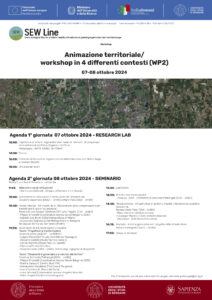
Day 1 — Research Lab
The recent infrastructure: reading the threads of a changing landscape
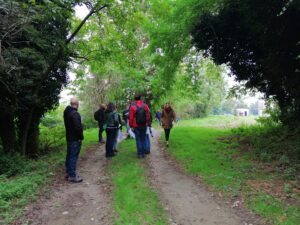
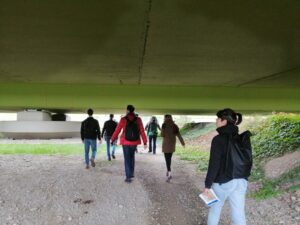
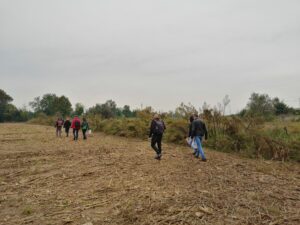
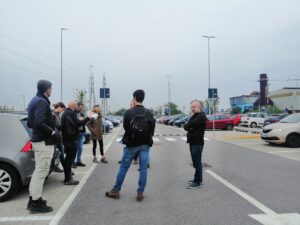
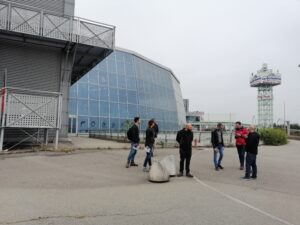
Exploring the relationships between infrastructure and landscape immediately after completion guided the selection of the east–west infrastructure corridor shaped by the A35 motorway and the HS/HC rail line (AV/AC) as the study area for the second Research Lab. Field activities took place in Fara Olivana con Sola and Romano di Lombardia (BG), near the crossing of the Serio River, within the Serio Regional Park.
The landscape investigated is characterised by a dense network of water features—springs (fontanili) and irrigation channels (rogge)—and by a complex layering of settlement traces. Through walking surveys along the infrastructure corridor, the working group observed that these networks of relations and material signs are still present, yet often hard to read due to the lack of cartographic tools sensitive to landscape dimensions. This gap makes it difficult to interpret existing systems and their ongoing transformations.
For this reason, alongside field reading and documentation, the Research Lab included an action to enrich and integrate existing mapping through an editathon developed in collaboration with Wikimedia Italia (Mattia Nappi and Lorenzo Stucchi). This work supported the development of a voluntary mapping methodology aimed at reconstructing and communicating landscape patterns, offering new interpretive tools to understand the relationship between recent infrastructure and its territorial context.
Day 2 – Infrastructures in operation
Impacts, transformations, and territorial governance
The workshop alternated introductory plenary moments with parallel working tables, with the goal of investigating an infrastructure in a consolidated operational phase and the territorial transformation processes it continues to trigger.
The opening roundtables outlined a critical picture of the impacts produced by linear infrastructures, showing how—alongside environmental compensation works—these corridors often attract new functions with a high demand for accessibility. This raises questions about rural territories’ capacity to govern transformations that are frequently infrastructure-induced rather than consciously planned.
Roundtable — “Infrastructure impacts: from environmental compensation to ‘parasitic’ functions”
The discussion addressed the management of impacts generated by linear infrastructures and the attraction of new functions in rural areas.
Participants: Isabella Susi Botto (Metropolitan City of Milan), Alessandro Dalpiano (Metropolitan City of Bologna), Filippo Simonetti (Bergamo 2030), Bertrando Bonfantini (Politecnico di Milano).
Roundtable — “Infrastructure and territory: impacts, interactions, and evolving spatial arrangements”
The exchange brought together the perspective of the infrastructure operator with that of environmental assessment.
Participants: Ilaria Napoli (A35 Brebemi Aleatica), Mario Zambrini (Ambiente Italia).Building on these contributions, local actors then joined two parallel working tables.
Working Table 1 — “Designing transformations”
The exchange among designers and experts questioned the current approach to infrastructure projects, which are often reduced to a set of technical and sector-based requirements. The discussion highlighted the need to move beyond fragmented project documentation and to reframe the project as a tool capable of imagining and guiding future functional relationships between infrastructure and landscape—treating the landscape not as a passive recipient of compensations, but as the project’s very matrix.
Participants: Giovanni Castelli and Letizia Mariotto (Studio Tecnico Castelli), Luigino Pirola (SAP Studio Architettura Paesaggio), Filomena Pomilio (Pro Iter), Dina Cattaneo (TESAF – University of Padua), Rosalba Ferrari (DISA – University of Bergamo / Order of Engineers of Bergamo).
Coordination and introduction: Anna Lei.
Working Table 2 — “Governing territorial transformations”
This table emphasised the importance of more collaborative and coordinated governance, capable of integrating institutions, economic actors, and local communities. Final reflections stressed that building shared visions is an essential condition for overcoming conflicts and fragmentation, and for responsibly guiding the formation of new territorial arrangements.
Participants: Immacolata Gravallese (Province of Bergamo), Laura Comandulli (Serio Regional Park), Fabio Corgiat (Confindustria Bergamo), Luca Bettinelli (Arco Blu Project), Evelina Saracchi (PIM Research Centre).
Coordination and introduction: Giovanni Giacomello.