
HIGH-SPEED RAIL: Governance models for the environmental planning of major infrastructure projects
Verona Living Lab, 22–23 April 2024
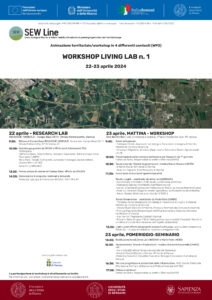
The first SEW Line Living Lab took place in Verona and focused on the High-Speed/High-Capacity rail project (AV/AC), with particular attention to the Verona–Vicenza section. The case was used as a simulated design and governance exercise to kick-start a structured discussion on environmental planning for major infrastructure. The seminar aimed to: collect and exchange inputs with local stakeholders, build a dedicated network on the topic, and develop early insights towards a shared manifesto for the environmental planning of large-scale infrastructures.
Day 1 — Research Lab 1
The infrastructure under construction: the construction site as a space for mediation
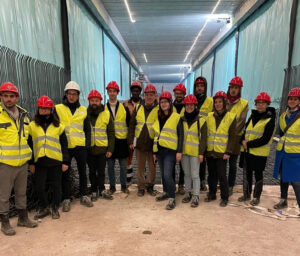
An in-progress analysis of the relationship between infrastructure and its territorial context guided the selection of the AV/AC Verona–Vicenza construction sites as the case study for SEW Line’s first Research Lab. Activities took place in San Martino Buon Albergo (VR) and at the CB IRICAVDUE/WEBUILD base camp (Verona East), through a site visit led by designers and technical managers.
The day combined:
-
direct observation of the technical solutions adopted during construction, and
-
a focused exchange with the teams responsible for design choices, sustainability strategies, and the mitigation/compensation measures planned along the corridor.
This dialogue created space to share initial critical insights emerging from the literature and prior experience—particularly regarding procedures and the limits of current operational practices. At the same time, it enabled the collection of feedback on the friction points between design and construction, highlighting the tensions and negotiations that shape the infrastructure–territory relationship during the building phase.
Day 2 — Workshop
Infrastructure under construction: design, places, and governance
The second day workshop followed the project’s shared format, alternating parallel working tables with plenary moments, with the goal of aligning design, institutional, and operational perspectives around the construction phase of major infrastructures.
Working Table 1 — “Places”
This table framed infrastructure design as a landscape project, questioning whether mitigation and compensation can move beyond a purely additive logic. Discussion highlighted the need for holistic, cross-scale, and replicable models to support the sustainable integration of infrastructure in rural and peri-urban landscapes, addressing biodiversity, environmental quality, and social equity together. In this perspective, the infrastructure edge was read not only as a line of separation, but as a strategic space from which to develop new, everyday landscapes—performative and, in some cases, productive.
Participants: Sara Ferraro (LAND), Francesco Garofalo (Openfabric), Elena Fontanella (Politecnico di Milano), Mauro Masiero (University of Padua), Federico Correale (Veneto Agricoltura).
Coordination and introduction: Anna Lei.
Working Table 2 — “Governance”
This table foregrounded critical issues linked to the coexistence of actors operating at different scales and with objectives that are not always aligned. The discussion showed how supra-local infrastructures can produce deep impacts on local communities, which do not always have adequate tools to influence decision-making. A key tension emerged between the need for stronger territorial involvement and the risk—perceived by investors—of increased procedural uncertainty.
Participants: Pierluigi Magnante (Confindustria Verona), Giovanni Bairo (Gruppo Pittini), Luca Bettinelli (local administrations).
Coordination and introduction: Mario Paris.
Plenary roundtables
Following the parallel tables, the workshop continued with two plenary roundtables. These sessions consolidated the key takeaways, stressing how public–private partnership and the early integration of environmental strategies are essential conditions to turn mitigation into a structuring territorial project, capable of delivering durable and shared benefits.
Roundtable — “Governance models”
The discussion explored innovative practices for infrastructure development and for mitigation/compensation measures, highlighting the role of public–private partnership and the integration of environmental strategies from the earliest project stages.
Participants: Antonio Mortali (KM Verde, Parma), Andrea Ballarin (CAV / Passante di Mestre).
Roundtable — “Major infrastructures”
The discussion addressed how to integrate biodiversity, ecosystem services, and natural capital into planning and management processes, emphasising the value of territorial dialogue as well as the governance challenges created by multiple stakeholders.
Participants: Carlo Costa (Autostrada del Brennero S.p.A.), Antonio Mortali (KM Verde, Parma), Stefano Carravieri (RFI).